Buying Property in Japan: Cash or Mortgage?
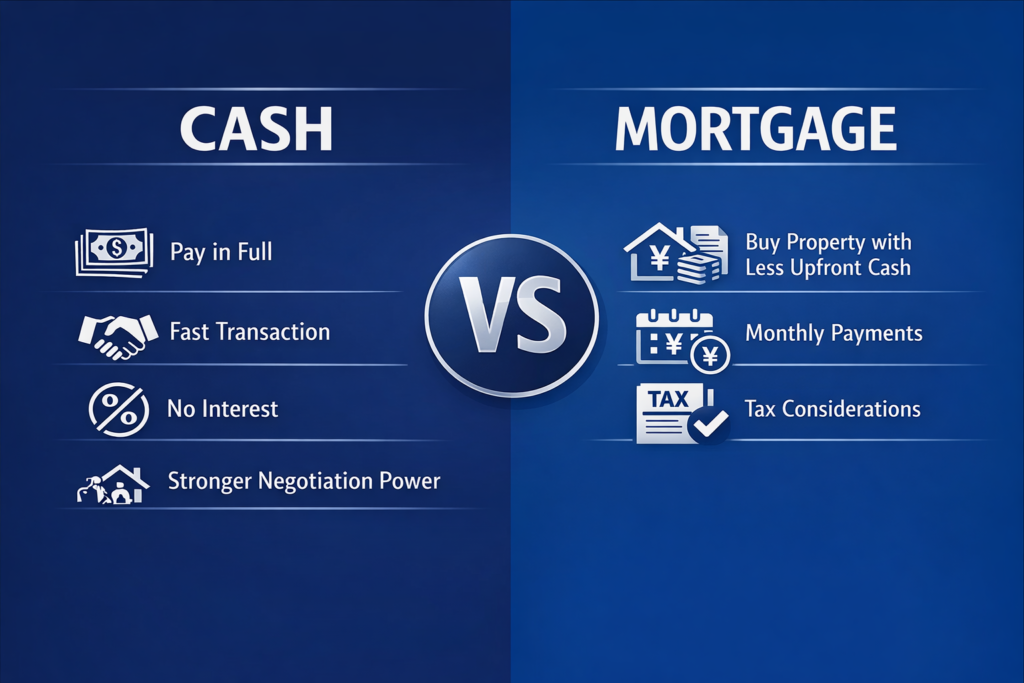
Most of our international clients choose to purchase property in Japan with cash.
However, depending on your situation, using a mortgage may also be an option.
So which approach is right for you?
Cash vs Mortgage — The Big Picture in Japan
While mortgages are commonly used by Japanese homebuyers, the situation is more complex for foreign buyers.
For foreigners purchasing property in Japan, using a mortgage often involves higher hurdles compared to many other countries.
Eligibility depends heavily on factors such as residency status, employment in Japan, and credit history within the country.
Using a Japanese Bank Mortgage
For foreign buyers, obtaining a mortgage from a Japanese bank is possible only in limited situations.
In most cases, Japanese banks require:
- Having lived in Japan for a certain period and demonstrating an intention to continue living in Japan long term
- Stable employment and income in Japan
- Evidence of income and tax payment history in Japan, depending on the bank
- Credit history within Japan, which may be taken into consideration
- In many cases, permanent residency status, which can be viewed favorably
- In many cases, communication with Japanese banks is conducted primarily in Japanese, which may further limit available options for English-only speakers
Please note that the points above reflect general tendencies, and actual requirements may vary depending on the bank and individual circumstances.
Because mortgage criteria differ from bank to bank, buyers considering a Japanese bank mortgage are strongly encouraged to speak directly with banks at an early stage of the process.
Clarifying potential borrowing capacity in advance helps avoid misunderstandings and allows for a more focused and realistic property search.
Overseas Buyers — Why Mortgages Are Rarely Realistic
For overseas residents, getting a mortgage from a Japanese bank is extremely difficult in most cases.
Japanese banks tend to be conservative when it comes to overseas income, currency risk, and loan enforcement.
Because of this, most overseas buyers who successfully purchase property in Japan do so with cash.
Non-Bank Financing Options (A Limited Alternative)
In recent years, a small number of non-bank lenders have started offering financing options for non-residents.
However, these options typically involve:
- Higher interest rates
- Limited eligible countries
- Significant upfront costs
- Longer approval timelines
- Strict lending conditions
For most buyers, these options are not practical unless there is a very specific reason.
Why Cash Buyers Are Strong in the Tokyo Market
Cash purchases offer several practical advantages in Tokyo’s luxury property market.
They allow for faster transactions, as the process does not depend on mortgage approval timelines.

Cash buyers may also be in a stronger position when multiple buyers are interested in the same property, particularly in high-demand locations.
In addition, cash transactions provide greater certainty for sellers and contribute to a smoother, more predictable closing process.
Conclusion
If you are considering purchasing property in Japan, understanding the financing landscape early is essential.
This financing reality is particularly relevant when considering high-end condominiums and residential properties in Tokyo.
In practice, many of my clients choose to purchase property in Japan without relying on financing, particularly in the Tokyo market.
If you would like professional guidance when considering a property purchase in Japan, I would be happy to assist.
If you are exploring property options in Tokyo,
we can assist with availability checks and viewing arrangements where appropriate.